The traditional route to business funding – bank loans – often presents significant hurdles for many entrepreneurs. Strict eligibility criteria, lengthy application processes, and rigid terms can stifle growth and innovation. Fortunately, a dynamic landscape of alternative financing options is emerging, offering businesses of all sizes more flexible and accessible funding solutions. This exploration delves into the diverse world of alternative financing, examining its advantages, disadvantages, and suitability for different business models.
This guide will navigate you through various financing avenues, from crowdfunding and peer-to-peer lending to invoice financing and revenue-based models. We’ll analyze the specific benefits and drawbacks of each, providing a framework for businesses to assess their needs and choose the most appropriate funding strategy. Understanding the implications of each option, including potential risks and ethical considerations, is paramount to making informed decisions that foster sustainable business growth.
Introduction to Alternative Financing
The traditional landscape of business financing, dominated by banks and traditional lending institutions, is often characterized by stringent requirements and lengthy approval processes. Small and medium-sized enterprises (SMEs), in particular, frequently face challenges securing loans due to limited credit history, insufficient collateral, or perceived high risk. Larger corporations, while having more access to traditional financing, may find themselves needing faster, more flexible solutions than traditional methods allow.
This creates a significant hurdle for businesses seeking capital to fuel growth, innovation, and expansion.The increasing demand for agile and adaptable financial solutions has fueled the rise of alternative financing. Businesses of all sizes are increasingly turning to these options to overcome the limitations of traditional lending. The need is particularly acute for startups and high-growth companies, which often lack the established track record required by traditional lenders.
Moreover, the speed and flexibility offered by alternative financing methods are proving invaluable in today’s dynamic business environment, where quick access to capital can be a decisive factor in seizing opportunities or navigating unexpected challenges.
Alternative Financing Defined
Alternative financing encompasses a broad range of funding sources and methods that lie outside the traditional banking system. Key characteristics include faster processing times, less stringent eligibility criteria, and a greater emphasis on assessing the potential of the business rather than solely relying on historical financial performance. These options often leverage technology to streamline the application process and provide more transparent and efficient access to capital.
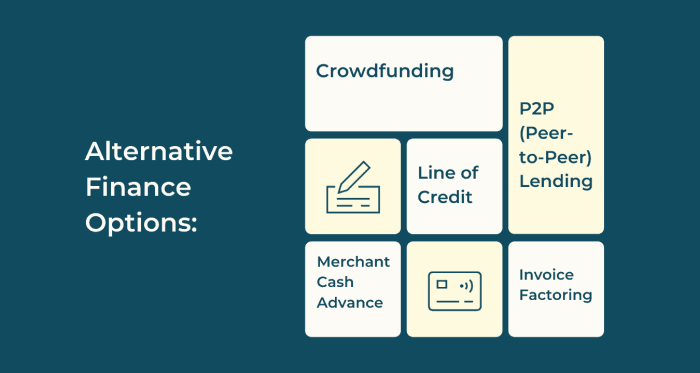
Examples include peer-to-peer lending, crowdfunding, invoice financing, and merchant cash advances. The diverse nature of these options allows businesses to tailor their funding strategy to their specific needs and circumstances.
Types of Alternative Financing
Securing funding for a business can be challenging, especially for startups or companies lacking extensive credit history. Traditional bank loans often come with stringent requirements and lengthy approval processes. Fortunately, a diverse range of alternative financing options exists, each with its own set of advantages and disadvantages. Understanding these options is crucial for entrepreneurs to choose the best fit for their specific needs and circumstances.
Alternative financing encompasses various methods of securing capital outside the traditional banking system. These options provide flexibility and accessibility to businesses that might not qualify for conventional loans. The selection process involves carefully weighing factors such as interest rates, repayment terms, and the overall impact on the company’s financial structure.
Crowdfunding (Equity and Debt)
Crowdfunding offers a powerful way to raise capital from a large pool of individuals. Equity crowdfunding involves selling a portion of your company’s ownership in exchange for funding, while debt crowdfunding involves borrowing money from many individuals who act as lenders. Equity crowdfunding dilutes ownership, but it doesn’t require repayment; debt crowdfunding requires repayment with interest, but it retains ownership.
Successful equity crowdfunding campaigns often leverage strong marketing and a compelling business narrative to attract investors. Debt crowdfunding platforms typically assess borrower creditworthiness and project viability before listing the opportunity.
Peer-to-Peer Lending
Peer-to-peer (P2P) lending platforms connect borrowers directly with individual lenders, bypassing traditional financial institutions. This approach can lead to more competitive interest rates and faster approval times compared to bank loans. However, eligibility criteria can vary significantly across platforms, and borrowers need to demonstrate a strong credit profile and a viable business plan. P2P lending often involves a detailed application process that includes financial statements and business projections.
Invoice Financing
Invoice financing provides immediate access to cash by using outstanding invoices as collateral. Businesses receive a percentage of their invoice value upfront, typically around 80-90%, and repay the loan when their clients pay the invoices. This method is particularly useful for businesses with a steady stream of invoices and strong client relationships. However, the interest rates can be relatively high, and it’s crucial to have reliable clients who pay invoices promptly.
Merchant Cash Advances
A merchant cash advance (MCA) is a lump-sum payment received in exchange for a percentage of future credit card sales. The repayment is automatically deducted from daily credit card transactions, making it a convenient option for businesses with consistent card sales. MCAs often come with high fees and can be expensive if not managed carefully. Eligibility typically depends on consistent credit card processing volume and a healthy business history.
Revenue-Based Financing
Revenue-based financing provides funding in exchange for a percentage of future revenue. Repayments are tied directly to the company’s revenue, making it a flexible option for businesses with fluctuating cash flows. This approach avoids fixed monthly payments and allows for scaling repayments based on business performance. However, the percentage of revenue ceded can be substantial, potentially impacting profitability.
| Financing Type | Advantages | Disadvantages | Eligibility Requirements |
|---|---|---|---|
| Crowdfunding (Equity) | Raises significant capital, no debt incurred | Dilutes ownership, time-consuming process | Compelling business plan, strong marketing |
| Crowdfunding (Debt) | Raises capital without diluting ownership | Requires repayment with interest, may be challenging to secure funding | Strong creditworthiness, viable business plan |
| Peer-to-Peer Lending | Competitive interest rates, faster approval | Eligibility criteria can be strict, requires strong credit | Good credit score, detailed business plan, financial statements |
| Invoice Financing | Quick access to cash, uses existing assets as collateral | High interest rates, relies on timely client payments | Strong client relationships, consistent invoice volume |
| Merchant Cash Advances | Convenient repayment, suitable for consistent card sales | High fees, can be expensive | Consistent credit card processing volume, healthy business history |
| Revenue-Based Financing | Flexible repayment based on revenue, avoids fixed payments | Can be costly if revenue is low, cedes a percentage of revenue | Demonstrable revenue stream, strong business projections |
Assessing the Suitability of Alternative Financing
Choosing the right financing method is crucial for a business’s success. A mismatch between a company’s needs and the financing option can lead to financial strain and hinder growth. Understanding your business’s specific circumstances and carefully evaluating alternative financing options is therefore paramount. This section will guide you through a process to ensure you select the most appropriate funding source.
Several key factors influence the suitability of alternative financing. Businesses must consider their current financial health, growth stage, risk tolerance, and long-term objectives. A startup, for example, will have vastly different needs and risk profiles compared to an established, profitable company. Understanding these differences is vital in making an informed decision.
Factors Influencing the Choice of Alternative Financing
Businesses should meticulously evaluate their financial position, operational history, and future projections before exploring alternative financing options. This assessment ensures that the chosen financing aligns with the company’s capabilities and goals, preventing potential financial distress.
- Financial Health: A thorough analysis of the company’s financial statements (balance sheet, income statement, cash flow statement) is essential. This reveals profitability, liquidity, and debt levels, directly impacting eligibility for various financing options. For instance, lenders will scrutinize these statements to assess creditworthiness before approving a loan. Businesses with strong financials have a wider range of options and better terms.
- Business Stage: The stage of business development significantly influences suitable financing options. Seed-stage companies might rely on angel investors or crowdfunding, while established businesses might consider mezzanine financing or asset-based lending. The risk profile associated with each stage dictates the type of financing that is most appropriate and accessible.
- Long-Term Goals: The chosen financing should align with the company’s long-term strategic objectives. If the goal is rapid expansion, equity financing might be preferred, while for sustainable growth, debt financing could be more suitable. Understanding the implications of each financing type on ownership, control, and future financial obligations is critical.
- Risk Tolerance: Different financing options carry varying levels of risk. Equity financing dilutes ownership but reduces financial burden, while debt financing maintains control but requires repayment with interest. A business’s risk appetite should guide the choice of financing to minimize potential negative consequences.
- Repayment Capacity: Before committing to any financing, businesses must realistically assess their ability to repay the debt or meet the obligations of equity financing. This involves projecting future cash flows and ensuring sufficient funds are available for repayments without compromising operational needs. Failure to accurately assess repayment capacity can lead to financial difficulties.
A Step-by-Step Process for Assessing Financing Needs and Choosing the Most Appropriate Option
A structured approach ensures a comprehensive evaluation of financing options, leading to a well-informed decision. This methodical process minimizes the risk of selecting an unsuitable funding source.
- Define Financing Needs: Clearly articulate the purpose of the financing (e.g., expansion, equipment purchase, working capital). Quantify the amount needed and the timeline for repayment or return on investment.
- Assess Financial Health: Conduct a thorough review of the company’s financial statements and identify strengths and weaknesses. This analysis provides a realistic assessment of eligibility for different financing options.
- Research Alternative Financing Options: Explore various options, considering factors such as interest rates, fees, repayment terms, and the impact on ownership. Compare the advantages and disadvantages of each option.
- Evaluate Suitability: Match the financing options with the company’s financial health, business stage, long-term goals, and risk tolerance. Prioritize options that align best with the company’s profile.
- Develop a Financial Plan: Create a detailed financial plan incorporating the chosen financing option. This plan should Artikel projected cash flows, repayment schedules, and potential risks.
- Secure Financing: Prepare the necessary documentation and applications for the chosen financing option. Negotiate terms and conditions to ensure they are favorable to the business.
- Monitor and Manage: Regularly monitor the financial performance and manage the financing effectively to ensure timely repayments and avoid potential financial issues.
Impact on Business Development and Strategy
Access to alternative financing can significantly shape a business’s trajectory, influencing its development, expansion plans, and overall strategic direction. The availability of diverse funding options allows businesses to pursue opportunities that might otherwise be unattainable through traditional lending channels. However, it’s crucial to understand the potential downsides and implement strategies to mitigate associated risks.Alternative financing options, such as crowdfunding, peer-to-peer lending, or invoice financing, can provide much-needed capital for startups, small businesses, and even established companies seeking rapid growth.
This injection of capital can fuel expansion into new markets, the development of innovative products or services, or the acquisition of competitors. Strategic decisions regarding investments in technology, marketing, and human capital can be significantly impacted by the ease and speed of access to these funds. For instance, a business facing a sudden surge in demand might leverage invoice financing to immediately address increased production needs, ensuring they meet customer expectations and avoid losing market share.
Risk Mitigation Strategies for Alternative Financing
The flexibility and speed of alternative financing come with inherent risks. These include higher interest rates, stringent repayment terms, and potential dilution of ownership (in the case of equity-based financing). Effective risk management requires careful planning and proactive measures. This involves thoroughly researching different financing options, comparing interest rates and fees, and developing a robust financial plan that demonstrates the ability to repay the loan.
Furthermore, businesses should diligently maintain strong financial records, accurately project cash flow, and establish contingency plans to address potential setbacks. Diversifying funding sources can also reduce reliance on a single, potentially risky, alternative financing option. For example, a small business might combine a small business loan with a crowdfunding campaign to reduce the financial burden associated with a single large loan.
Hypothetical Business Scenario: The Impact of Invoice Financing
Imagine “Artisan Breads,” a rapidly growing bakery specializing in handcrafted sourdough loaves. Demand for their products has significantly increased, but their current cash flow is insufficient to meet the growing production needs. They are considering two options: taking out a traditional bank loan (which has a lengthy approval process and stringent requirements) or utilizing invoice financing.Choosing invoice financing allows Artisan Breads to immediately access capital by selling their outstanding invoices to a financing company at a discount.
This allows them to purchase additional ingredients, hire extra staff, and increase production to meet the surge in demand. The quicker access to capital allows Artisan Breads to capitalize on the increased demand, strengthening their market position and potentially accelerating their growth trajectory. However, the discount on the invoices reduces their overall profit margin. If demand unexpectedly slows, they might struggle to meet the repayment schedule.
Therefore, a thorough assessment of the risks and benefits, along with a realistic projection of future sales, is crucial before committing to invoice financing. Had Artisan Breads opted for the traditional bank loan, they might have missed the opportunity to capitalize on the increased demand, potentially losing market share to competitors.
Ethical Considerations in Alternative Financing
Alternative financing, while offering valuable opportunities for businesses, presents unique ethical challenges that require careful consideration. The inherent flexibility and often less stringent regulatory oversight compared to traditional lending can create situations where ethical boundaries become blurred. Understanding these potential pitfalls and proactively implementing ethical practices is crucial for both businesses seeking funding and the providers of these alternative financing options.Ethical dilemmas in alternative financing often stem from a lack of transparency, potential for predatory lending practices, and the complexities of assessing risk accurately within rapidly evolving markets.
For example, a business might face pressure to accept a loan with exorbitant interest rates and hidden fees simply because traditional financing is unavailable. Similarly, alternative lenders may prioritize profit maximization over a thorough assessment of a borrower’s ability to repay, leading to unsustainable debt burdens.
Examples of Ethical Dilemmas
Several scenarios illustrate the ethical complexities of alternative financing. A small business owner might be tempted to misrepresent their financial situation to secure funding, while an alternative lender might fail to disclose all associated fees and risks clearly. Another example involves crowdfunding platforms where campaigns might exaggerate their potential or fail to deliver on promises made to investors.
These situations highlight the need for robust ethical guidelines and responsible behavior from all parties involved.
Guidelines for Ethical Practices in Alternative Financing
Businesses seeking alternative financing should prioritize transparency in their financial disclosures, actively seeking options that align with their long-term financial health. They should thoroughly research lenders, compare terms and conditions, and avoid accepting offers that appear too good to be true. A crucial aspect is maintaining open communication with lenders, promptly addressing any concerns or changes in their financial situation.Alternative lenders, on the other hand, have an ethical responsibility to conduct thorough due diligence, ensure complete transparency in their lending practices, and avoid predatory lending tactics.
This includes clearly disclosing all fees, interest rates, and repayment terms, as well as providing borrowers with adequate support and resources to manage their debt effectively. Fair and responsible lending practices build trust and contribute to a sustainable and ethical alternative financing ecosystem.
Transparency and Responsible Borrowing
Transparency is paramount in all aspects of alternative financing. Businesses should clearly understand the terms of their agreements, including any hidden fees or penalties. Similarly, lenders should provide detailed information about their lending criteria, interest rates, and repayment schedules. Responsible borrowing involves careful consideration of the financial implications of the loan, ensuring that the business can comfortably meet its repayment obligations without compromising its long-term financial stability.
This includes developing a comprehensive repayment plan and proactively managing cash flow to mitigate potential risks. Failure to do so can lead to financial distress and negatively impact the business’s reputation and creditworthiness.
The Role of Business Coaching and Mentorship
Navigating the complex world of alternative financing can be challenging for even the most seasoned entrepreneurs. The sheer variety of options, coupled with the often-technical requirements and potential risks, makes expert guidance invaluable. Business coaching and mentorship provide that crucial support, helping businesses make informed decisions and maximize their chances of securing the right funding.A skilled business coach acts as a strategic partner, guiding entrepreneurs through every stage of the financing process.
This includes identifying the business’s financing needs, developing a comprehensive funding strategy, researching and evaluating various alternative financing options, and preparing compelling applications. Their expertise extends beyond simply finding funding; they help businesses understand the implications of different financing choices on their long-term growth and sustainability.
Developing a Comprehensive Financing Strategy
A business coach assists in creating a robust financing strategy tailored to the specific needs and goals of the business. This involves a thorough assessment of the business’s current financial position, future projections, and risk tolerance. The strategy Artikels the type and amount of funding required, the timeline for securing the funds, and a plan for managing debt or equity investments.
For example, a coach might help a small tech startup develop a phased funding strategy, starting with bootstrapping and angel investors, and then progressing to Series A venture capital as the business scales. This phased approach mitigates risk and allows the business to adapt to changing circumstances.
Selecting Appropriate Financing Options
Choosing the right financing option is critical. A business coach provides guidance on various alternatives, including peer-to-peer lending, crowdfunding, invoice financing, merchant cash advances, and revenue-based financing. They help businesses understand the advantages and disadvantages of each option, considering factors such as interest rates, fees, repayment terms, and the impact on ownership and control. For instance, a coach might advise a rapidly growing e-commerce business to explore revenue-based financing, as it aligns with their revenue streams and avoids diluting equity.
Conversely, a more established business with strong assets might be better suited to a traditional bank loan or invoice financing.
Benefits of Expert Advice Before Committing to Alternative Financing
Seeking expert advice before committing to any alternative financing arrangement offers numerous benefits. A coach can help businesses avoid costly mistakes, such as taking on excessive debt or choosing a financing option that doesn’t align with their business model. They can also negotiate favorable terms with lenders or investors, ensuring the business secures the best possible deal. Furthermore, a mentor’s experience can help businesses navigate the complexities of legal and regulatory requirements, minimizing the risk of compliance issues.
In essence, proactive engagement with a business coach significantly increases the likelihood of a successful financing outcome and reduces the potential for negative consequences.
Business Loans vs. Alternative Financing
Securing funding for a business can be a complex process, and understanding the differences between traditional business loans and alternative financing options is crucial for making informed decisions. Both methods offer access to capital, but they differ significantly in their requirements, terms, and overall impact on a business. This section will Artikel the key distinctions to help entrepreneurs choose the most suitable path for their specific needs.Traditional business loans and alternative financing options present distinct advantages and disadvantages.
A thorough understanding of these differences is vital for entrepreneurs seeking to optimize their financial strategies. The choice between these two avenues depends heavily on the business’s financial health, credit history, and the nature of its funding needs.
Comparison of Traditional Business Loans and Alternative Financing
Traditional business loans, typically offered by banks and credit unions, are characterized by a formal application process, stringent credit checks, and detailed financial documentation requirements. Approval often hinges on a strong credit score and a proven track record of financial stability. These loans usually come with fixed interest rates and repayment schedules, providing predictability but potentially limiting flexibility.
Conversely, alternative financing options, such as invoice financing, merchant cash advances, or crowdfunding, offer a faster and less rigorous application process, often catering to businesses with less-than-perfect credit. However, they typically come with higher interest rates and potentially less favorable repayment terms. The flexibility of alternative financing can be advantageous in situations requiring quick access to capital, but the higher cost needs careful consideration.
Scenarios Favoring Alternative Financing over Traditional Business Loans
Several situations make alternative financing a more attractive option. For instance, businesses experiencing rapid growth but lacking a long credit history might find traditional loans inaccessible. Startups with innovative but unproven business models may also struggle to secure traditional financing. In cases where immediate funding is crucial, such as covering urgent operational expenses or seizing a time-sensitive opportunity, the faster turnaround time of alternative financing can be a decisive factor.
Businesses with seasonal revenue fluctuations might also benefit from alternative options that align with their cash flow patterns, avoiding the rigid repayment schedules of traditional loans. Finally, businesses needing smaller amounts of capital might find alternative financing more efficient and less cumbersome than navigating the complexities of a traditional bank loan.
Scenarios Favoring Traditional Business Loans over Alternative Financing
Conversely, traditional business loans remain preferable in certain circumstances. For businesses with established creditworthiness and a strong financial history, securing a traditional loan can result in significantly lower interest rates and more favorable repayment terms compared to alternative financing. The longer repayment periods often associated with traditional loans can ease the financial burden, particularly for substantial investments. Moreover, traditional loans often come with more predictable and transparent terms, reducing the potential for unforeseen costs or complexities.
Finally, the structured nature of a traditional loan can be advantageous for long-term strategic planning and financial forecasting.
Interest Rates and Repayment Terms: A Visual Comparison
Imagine a simple bar graph. The horizontal axis represents the financing method: “Traditional Business Loan” and “Alternative Financing.” The vertical axis represents the interest rate (as a percentage) and repayment period (in months).For “Traditional Business Loan,” the interest rate bar might be relatively short, representing a lower percentage (e.g., 5-8%), while the repayment period bar would be longer, reflecting a longer timeframe (e.g., 36-60 months).For “Alternative Financing,” the interest rate bar would be significantly taller, indicating a much higher percentage (e.g., 15-30%), and the repayment period bar would be shorter, representing a faster repayment schedule (e.g., 6-12 months).
This visual representation highlights the trade-off between speed and cost associated with each financing method. This is a simplified example; actual rates and terms vary widely depending on several factors.
Alternative Financing and Business Models
The choice of financing significantly impacts a business’s trajectory, particularly when considered in conjunction with its underlying business model. Different models, with their unique revenue streams and operational structures, necessitate varying financing approaches. Understanding this interplay is crucial for sustainable growth and scalability. A mismatch between financing and business model can lead to financial instability and hinder long-term success.The suitability of alternative financing options is heavily influenced by a business’s revenue model, operational structure, and growth trajectory.
For instance, a subscription-based business with predictable recurring revenue might find invoice financing or revenue-based financing more suitable than a startup relying on venture capital. Similarly, a company with significant physical assets might leverage asset-based lending, while a technology company might prefer equity financing. The scalability and sustainability of the business model directly influence the type and amount of financing needed.
Revenue Model Influence on Financing Choices
Businesses with diverse revenue streams often require a blended financing approach. A company generating revenue from both product sales and service contracts might utilize a combination of bank loans for working capital and equity financing to fund expansion. Conversely, a business relying solely on a single product launch might need to secure bridge financing to cover initial production costs before generating revenue.
This highlights the need for a tailored financing strategy aligned with the specifics of the revenue generation process.
Operational Structure and Financing Strategy
The operational structure of a business significantly affects its financing needs and options. A franchise model, for example, might leverage franchise fees and royalties to secure financing, while a purely online business might seek alternative options like crowdfunding or peer-to-peer lending. A capital-intensive business, such as manufacturing, would likely require larger loans or equity investments compared to a service-based business with lower upfront capital requirements.
The operational complexity and resource intensity are key factors determining the feasibility and appropriateness of different financing methods.
Impact of Financing on Scalability and Sustainability
The choice of financing directly impacts a business’s scalability and sustainability. Debt financing, while providing immediate capital, can burden a business with repayment obligations, potentially hindering growth if revenue projections are not met. Equity financing, while diluting ownership, can provide the necessary capital for expansion without immediate repayment pressure. Revenue-based financing aligns payments with revenue generation, mitigating risk for both the business and the lender.
The selection of financing should carefully consider the long-term implications on the business’s ability to scale operations while maintaining financial stability. For example, a bootstrapped business might limit its growth potential compared to a venture-backed company. Similarly, a business heavily reliant on short-term debt may struggle to navigate economic downturns.
Business Travel and Financing
Business travel is a crucial aspect of many businesses, particularly those involved in sales, consulting, or international trade. However, the costs associated with travel – flights, accommodation, transportation, and meals – can significantly impact a company’s budget. Understanding how to finance these expenses and strategically manage them is vital for maintaining profitability and achieving business goals.Effective financing for business travel ensures that essential trips are undertaken without compromising the company’s financial stability.
This involves carefully considering the various financing options available, from traditional business loans to alternative financing solutions like lines of credit or invoice financing, and aligning the chosen method with the company’s overall financial strategy and risk tolerance. The impact of travel costs on financial planning is considerable, and proper management is essential for maintaining accurate financial forecasts and ensuring sufficient working capital.
Travel Costs and Financial Planning
Travel expenses can represent a substantial portion of a company’s operational budget, especially for businesses with frequent travel requirements. Incorporating these costs into the financial planning process is crucial for accurate budgeting and forecasting. Failure to adequately account for travel expenses can lead to cash flow problems and inaccurate financial projections. For example, a small consulting firm that neglects to budget for client visits might find itself short of funds for payroll or other critical expenses.
Alternative financing options can help mitigate this risk by providing access to funds when needed, allowing for a more flexible approach to managing travel costs.
Optimizing Business Travel Expenses
Several strategies can significantly reduce business travel expenses without sacrificing the effectiveness of trips. Negotiating favorable rates with airlines and hotels through corporate accounts or travel agencies can yield substantial savings. Utilizing video conferencing or other remote communication technologies for meetings can reduce the need for travel in some instances. Careful planning of itineraries, choosing cost-effective accommodation, and utilizing public transportation whenever possible can further minimize costs.
For example, a company might opt for a slightly longer flight with a lower fare instead of a quicker, more expensive option. These cost-saving measures should be implemented without compromising the quality or effectiveness of the business travel itself.
Alternative Financing for Business Travel
Alternative financing methods can offer flexible and accessible solutions for managing business travel costs. Lines of credit, for example, can provide readily available funds to cover travel expenses as they arise, eliminating the need for large upfront payments. Invoice financing can be utilized if the business anticipates receiving payments from clients after the travel is completed, providing immediate access to funds based on future receivables.
These options offer greater flexibility compared to traditional loans, which often involve more stringent requirements and longer processing times. The selection of the most appropriate alternative financing method will depend on the specific needs and financial situation of the business.
Securing the right financing is crucial for business success, and the availability of alternative options empowers entrepreneurs with greater control and flexibility. By carefully weighing the advantages and disadvantages of each method, understanding the ethical implications, and seeking expert guidance when necessary, businesses can confidently navigate the financing landscape and optimize their growth trajectory. Ultimately, a well-informed approach to alternative financing can unlock significant opportunities and pave the way for sustainable and prosperous ventures.
FAQ Overview
What is the typical processing time for alternative financing options?
Processing times vary significantly depending on the type of financing and the lender. Some options, like merchant cash advances, can be approved within days, while others, such as crowdfunding campaigns, may take weeks or even months.
Are there any hidden fees associated with alternative financing?
Yes, some alternative financing options may involve hidden fees or charges beyond the stated interest rate. It’s crucial to carefully review all terms and conditions before committing to any agreement to avoid unexpected costs.
How does my credit score impact my eligibility for alternative financing?
The impact of your credit score varies depending on the specific financing option. While some lenders prioritize credit scores, others may place more emphasis on factors like revenue, cash flow, and business performance.
What happens if I can’t repay my alternative financing?
The consequences of defaulting on alternative financing can be severe, potentially leading to legal action, damage to your credit score, and even business closure. It’s vital to carefully consider your repayment capacity before seeking any financing.