
Growth hacking, a data-driven approach to business expansion, offers a compelling alternative to traditional marketing. It prioritizes rapid experimentation and iterative improvement, leveraging digital channels and innovative strategies to achieve exponential growth. This approach focuses on identifying and exploiting key growth levers, often involving creative marketing tactics and a deep understanding of customer behavior.
Unlike traditional marketing’s broad strokes, growth hacking utilizes a more agile, experimental methodology. It emphasizes measurable results and continuous optimization, relying heavily on data analytics to inform decisions and refine strategies. By combining marketing savvy with a deep understanding of technology and user behavior, businesses can achieve significant gains in market share and revenue.
Defining Growth Hacking for Business Development
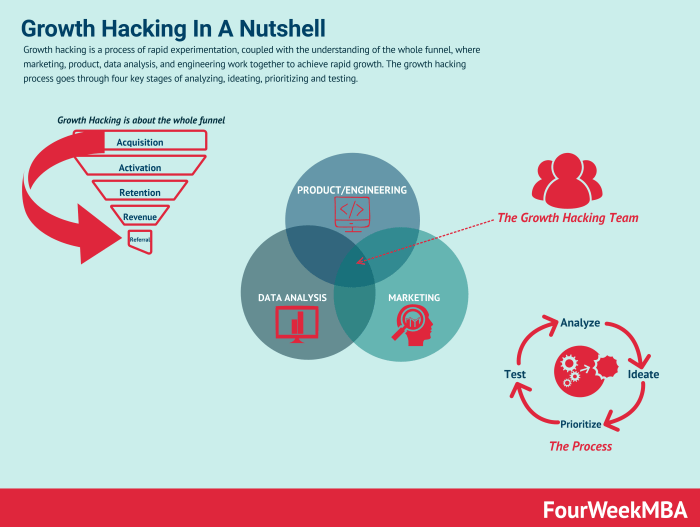
Growth hacking, in the context of business development, is a data-driven approach to rapidly expanding a company’s reach and user base. Unlike traditional marketing, which often relies on broad-based campaigns and brand building, growth hacking emphasizes experimentation, iterative improvements, and a focus on measurable results. It leverages unconventional strategies and technologies to achieve rapid, scalable growth.Growth hacking prioritizes rapid experimentation and learning over long-term brand building strategies.
Traditional marketing often focuses on building brand awareness through consistent messaging across various channels, relying heavily on established methods with potentially slower results and higher costs. Growth hacking, conversely, employs agile methodologies, testing numerous hypotheses quickly and iteratively to identify what resonates most effectively with the target audience. This data-driven approach allows for quick adaptation and optimization, leading to a faster return on investment.
Core Principles of Growth Hacking
Growth hacking operates on several key principles. A central tenet is the prioritization of measurable results. Every initiative is carefully tracked, analyzed, and optimized based on its contribution to key metrics. This data-driven approach allows for continuous improvement and efficient resource allocation. Another key principle is the focus on experimentation.
Growth hackers constantly test new ideas and strategies, iterating based on the results. This iterative process allows them to quickly identify what works and what doesn’t, maximizing their efficiency and minimizing wasted resources. Finally, growth hacking emphasizes a deep understanding of the target audience. By leveraging data and analytics, growth hackers gain insights into customer behavior and preferences, enabling them to tailor their strategies for maximum impact.
Examples of Successful Growth Hacking Strategies
Dropbox used a referral program where users earned extra storage space for each referral, organically growing their user base exponentially. This leveraged the power of word-of-mouth marketing and social proof. Hotmail cleverly embedded a promotional message at the end of every outgoing email, effectively turning every user into a walking advertisement. This ingenious approach harnessed the existing infrastructure to reach a wider audience.
Airbnb utilized strategic partnerships with travel blogs and websites to expand their reach to a global audience, leveraging existing networks and trust.
Case Study: Dropbox’s Growth Trajectory
Dropbox’s phenomenal growth is a prime example of the power of growth hacking. Initially, their focus was on creating a seamless user experience and offering a valuable product. However, their real breakthrough came from their viral referral program. By incentivizing users to invite friends, they leveraged the power of word-of-mouth marketing and created a self-sustaining growth engine.
This, combined with a strong focus on user experience and product development, allowed them to rapidly acquire millions of users without significant traditional marketing expenditure.
Key Performance Indicators (KPIs) for Growth Hacking
Measuring the success of growth hacking initiatives requires a focus on relevant KPIs. These often include metrics like customer acquisition cost (CAC), customer lifetime value (CLTV), viral coefficient, and daily/monthly active users (DAU/MAU). Tracking these KPIs allows growth hackers to understand the efficiency of their campaigns and make data-driven decisions to optimize their strategies. Furthermore, conversion rates (e.g., signup rates, free-to-paid conversion rates) are crucial indicators of the effectiveness of growth hacking efforts in turning leads into paying customers.
Analyzing these metrics allows for continuous improvement and informed decision-making, maximizing the return on investment of growth hacking activities.
Identifying Target Audience and Market Research
Understanding your target audience and conducting thorough market research are foundational to successful growth hacking. Without a clear picture of who you’re trying to reach and what their needs are, your efforts will be scattered and ineffective. This section details how to define your ideal customer and leverage market research to uncover opportunities for growth.
Buyer Persona Design for a Hypothetical Business
Let’s create a buyer persona for a hypothetical business: “EcoFlow,” a company selling sustainable, stylish reusable water bottles. Our ideal customer, “Sarah,” is a 28-year-old female living in a major metropolitan area. She’s environmentally conscious, health-conscious, and active on social media, particularly Instagram and TikTok. She works in a creative field (e.g., graphic design) and values experiences over material possessions.
She’s likely to be influenced by online reviews and social proof. Sarah’s online behavior includes frequent searches for eco-friendly products, following sustainable living influencers, and engaging with brands that align with her values. She has a disposable income that allows her to invest in higher-quality, sustainable products.
Market Research Methods for Identifying Unmet Needs
Effective market research is crucial for identifying unmet needs and opportunities. Several methods can be employed, including: Surveys (online and in-person) to gather quantitative and qualitative data directly from potential customers; Focus groups to understand customer perspectives and needs in a group setting; Competitor analysis to identify gaps in the market and areas for differentiation; Social listening to monitor online conversations and identify trends; and research to understand what terms people use when searching for products or services similar to yours.
By combining these methods, EcoFlow can gain a comprehensive understanding of the market and identify specific unmet needs within the sustainable water bottle niche, such as a lack of stylish, high-quality options with integrated filtration systems.
Marketing Plan Targeting a Defined Customer Segment
EcoFlow’s marketing plan will leverage growth hacking techniques to reach Sarah and her demographic. This will involve: Influencer marketing on Instagram and TikTok, targeting sustainable living influencers with a large following of Sarah’s demographic; Content marketing focusing on the benefits of reusable water bottles and EcoFlow’s unique features (e.g., stylish design, integrated filtration); Paid social media advertising on platforms like Instagram and Facebook, targeting users based on interests and demographics; Email marketing to nurture leads and build brand loyalty; Referral programs to incentivize existing customers to refer new ones; and A/B testing across all channels to continuously optimize campaigns.
Importance of A/B Testing in Optimizing Growth Hacking Campaigns
A/B testing is vital for optimizing growth hacking campaigns. It involves creating two versions of a marketing element (e.g., ad copy, landing page, email subject line) and comparing their performance to determine which version is more effective. For instance, EcoFlow might A/B test two different ad creatives – one focusing on the environmental benefits and the other on the stylish design – to see which resonates better with their target audience.
By continuously testing different elements, EcoFlow can refine its campaigns, improve conversion rates, and maximize its return on investment. This iterative process is central to the agile nature of growth hacking.
Viral Marketing and Content Strategies
Effective viral marketing and a robust content strategy are crucial for rapid business growth. By leveraging the power of social sharing and engaging content, businesses can significantly expand their reach and build strong brand awareness without relying solely on traditional advertising methods. This section will explore how to design viral campaigns and create a diverse content calendar to maximize impact.
A well-defined viral marketing campaign combined with a strategic content calendar forms the backbone of a successful growth hacking strategy. It’s about creating content so compelling that people naturally share it, amplifying your message exponentially and organically building your brand presence. This requires understanding your target audience, crafting engaging narratives, and utilizing various content formats to cater to different preferences.
Viral Marketing Campaign Concept for a New Product Launch
This section details a viral marketing campaign concept for the launch of “Aura,” a new noise-canceling headphone designed for productivity and relaxation. The campaign will center around the concept of “Unplug and Focus.” We will leverage user-generated content and influencer marketing to maximize reach and engagement. The campaign will launch with a short, visually stunning video showcasing the headphones’ sleek design and highlighting their noise-canceling capabilities in various settings (a busy coffee shop, a bustling city street, a quiet home office).
This video will be shared across all major social media platforms with a strong call to action: users who share the video and tag three friends will be entered into a contest to win a free pair of Aura headphones. Simultaneously, we will partner with productivity and wellness influencers to review and promote the product, further driving organic reach and building credibility.
The campaign will track key metrics such as video views, shares, and website traffic to measure effectiveness and adapt the strategy as needed.
Content Calendar for the Wellness Industry
This example showcases a content calendar for a wellness brand focused on yoga and mindfulness. The calendar spans one month, incorporating diverse content formats to engage a broad audience.
A diverse content calendar ensures consistent engagement and reaches a wider audience segment. The variety of formats caters to different consumption preferences and keeps the content fresh and interesting.
| Week | Monday | Wednesday | Friday |
|---|---|---|---|
| Week 1 | Blog Post: “5 Yoga Poses to Relieve Stress” | Instagram Reel: Short yoga flow video | Infographic: Benefits of Daily Meditation |
| Week 2 | Video: Interview with a yoga instructor | Blog Post: “Mindfulness Techniques for Beginners” | Instagram Story Q&A with a wellness expert |
| Week 3 | Infographic: Nutrition tips for improved energy | Facebook Live: Yoga class | Blog Post: “Creating a calming home environment” |
| Week 4 | Video: Timelapse of a yoga session | Instagram Reel: Highlighting customer testimonials | Blog Post: “The science behind mindfulness” |
Examples of Successful Viral Marketing Campaigns and Key Elements
The “Dove Real Beauty Sketches” campaign, which used a forensic artist to draw women based on their self-descriptions versus descriptions by strangers, went viral due to its emotional resonance and powerful message of self-acceptance. The campaign’s success stemmed from its authenticity, emotional appeal, and its ability to spark conversation and generate user-generated content. Similarly, Old Spice’s “The Man Your Man Could Smell Like” campaign utilized humorous and unexpected video content, creating a memorable and shareable experience.
Key elements included creative storytelling, unexpected humor, and a strong call to action.
The Role of User-Generated Content in Building Brand Awareness and Driving Growth
User-generated content (UGC) plays a vital role in building brand authenticity and driving growth. By encouraging customers to create and share their own content related to the brand, businesses can leverage the power of social proof and build stronger relationships with their audience. UGC often feels more authentic and relatable than traditional marketing materials, leading to increased trust and engagement.
For example, a travel company might encourage users to share photos of their trips using a branded hashtag, creating a visual gallery of positive experiences that attract potential customers. This not only builds brand awareness but also fosters a sense of community around the brand.
Growth Hacking and Business Development Synergies
Growth hacking and traditional business development, while both aiming for business expansion, employ distinct approaches. Traditional methods often rely on established, predictable strategies like extensive market research, carefully planned advertising campaigns, and long-term relationship building. Growth hacking, conversely, prioritizes rapid experimentation, data-driven decision-making, and leveraging unconventional channels to achieve fast, scalable growth. Understanding their interplay is crucial for maximizing business impact.Growth hacking’s agile, iterative nature complements the more structured approach of traditional business development.
The synergy lies in combining the speed and creativity of growth hacking with the strategic depth and long-term vision of traditional methods. This allows businesses to rapidly test and validate new ideas, refine their strategies based on real-time data, and ultimately achieve sustainable growth.
Comparison of Growth Hacking and Traditional Business Development Strategies
Traditional business development typically involves a longer sales cycle, focusing on building strong relationships and brand loyalty over time. Strategies often include networking, attending industry events, and direct sales. Conversely, growth hacking focuses on short-term gains through rapid experimentation with different marketing channels and techniques. This approach prioritizes measurable results and scalability, often utilizing viral marketing and A/B testing to optimize campaigns.
While traditional methods are valuable for building a solid foundation and brand recognition, growth hacking provides the tools for rapid expansion and market penetration.
Key Areas Where Growth Hacking Impacts Business Development
Growth hacking significantly impacts several key areas of business development. First, it accelerates customer acquisition by identifying and exploiting untapped growth opportunities through data analysis and rapid experimentation. Second, it enhances customer retention by employing techniques such as personalized email marketing and in-app messaging to foster engagement and loyalty. Third, it improves brand awareness by leveraging social media and viral marketing strategies to reach a wider audience.
Finally, it optimizes marketing spend by focusing resources on high-performing channels and techniques, ensuring a better return on investment. For example, a company might use growth hacking to identify a highly engaged segment on a specific social media platform, allowing them to target their marketing efforts effectively, leading to higher conversion rates compared to a broader, less targeted approach.
Ethical Considerations in Growth Hacking
Ethical considerations are paramount in implementing growth hacking strategies. Transparency and honesty are crucial; deceptive practices, such as misleading advertising or manipulating user data, can severely damage a company’s reputation and lead to legal repercussions. Privacy concerns must be addressed, ensuring compliance with data protection regulations. Growth hacking should always prioritize user experience and avoid manipulative tactics that could negatively impact customer trust.
A responsible approach involves focusing on providing value to the customer while achieving business objectives. For instance, a growth hacking campaign that uses dark patterns to trick users into making unwanted purchases would be unethical and potentially harmful.
Enhancing Growth Hacking with Business Coaching
Business coaching can significantly enhance the effectiveness of growth hacking initiatives. A coach can provide valuable guidance on strategic planning, identifying key performance indicators (KPIs), and developing a data-driven approach to experimentation. They can also help refine the growth hacking team’s skills, fostering collaboration and ensuring alignment with overall business goals. Furthermore, a coach can offer support in overcoming challenges and navigating the complexities of implementing growth hacking strategies.
For example, a coach could help a team struggling with A/B testing by providing frameworks for defining hypotheses and interpreting results effectively. This ensures that the team learns from its experiments and iterates quickly, maximizing the impact of its efforts.
Financial Aspects of Growth Hacking
Growth hacking, while focused on rapid user acquisition and engagement, requires a sound financial strategy for sustainable success. Understanding the financial implications of different growth hacking tactics is crucial for maximizing ROI and ensuring the long-term viability of your campaigns. Ignoring the financial aspects can lead to wasted resources and ultimately, failure.
Utilizing Business Loans for Growth Hacking Campaigns
Securing a business loan can provide the necessary capital to fuel ambitious growth hacking initiatives. Loans can be used to fund various aspects of a campaign, including paid advertising on social media platforms, influencer marketing collaborations, development of new software features, or the hiring of specialized growth hacking talent. The choice of loan type – such as a term loan, line of credit, or SBA loan – depends on the specific needs and financial health of the business.
It’s crucial to carefully evaluate the loan terms, interest rates, and repayment schedule to ensure it aligns with the projected return on investment from the growth hacking campaign. For example, a small business seeking to expand its social media presence might secure a small business loan to fund a targeted advertising campaign on platforms like Facebook or Instagram, expecting increased sales and brand awareness to cover the loan and generate profit.
Impact of Business Model on Growth Hacking Feasibility and Success
The business model significantly influences the feasibility and potential success of growth hacking strategies. A subscription-based model, for instance, might benefit from growth hacking tactics focused on user retention and lifetime value, while a transactional model might prioritize rapid customer acquisition and conversion. A freemium model could leverage growth hacking to drive conversions from free users to paying subscribers.
Businesses with low profit margins might find certain growth hacking strategies, such as paid advertising, less feasible than those with higher margins. Conversely, a business with a high customer acquisition cost might need to focus on organic growth strategies to ensure profitability. For example, a SaaS company with a subscription-based model would prioritize user retention through email marketing and in-app engagement features, whereas an e-commerce store might focus on paid advertising to drive immediate sales.
Creating a Financial Model to Assess ROI of Growth Hacking Approaches
A robust financial model is essential for evaluating the return on investment (ROI) of different growth hacking approaches. This model should incorporate key metrics such as customer acquisition cost (CAC), customer lifetime value (CLTV), conversion rates, and the cost of each growth hacking tactic. The model should project revenue generated from each campaign and compare it to the total expenditure.
A simple ROI calculation can be represented as:
ROI = (Net Profit / Cost of Investment) x 100
For example, a campaign costing $10,000 that generates $25,000 in revenue would have an ROI of 150%. This model allows businesses to compare the effectiveness of various growth hacking strategies and prioritize those with the highest potential ROI. Sophisticated models might incorporate probabilistic forecasting to account for uncertainty in future outcomes.
Budgeting and Resource Allocation in a Growth Hacking Strategy
Effective budgeting and resource allocation are paramount for successful growth hacking. A detailed budget should Artikel the costs associated with each tactic, including personnel, tools, and advertising expenses. Resources should be allocated strategically based on the projected ROI and the overall business goals. It’s crucial to track expenses and monitor the performance of each tactic to ensure resources are being used efficiently.
Regular review and adjustment of the budget are essential to adapt to changing market conditions and campaign performance. For instance, a company might initially allocate a larger budget to paid advertising, but after analyzing results, shift resources towards content marketing if it proves to be more cost-effective. This iterative approach ensures optimal resource utilization and maximizes the overall impact of the growth hacking strategy.
Strategic Planning and Long-Term Growth
Growth hacking, while focused on rapid results, isn’t a sprint; it’s a marathon. Sustainable business growth requires a strategic, long-term approach that integrates growth hacking principles into the core business strategy. This ensures consistent progress and avoids the pitfalls of short-lived viral campaigns that fail to build lasting value.A successful long-term growth hacking strategy relies on a deep understanding of the business’s strengths, weaknesses, opportunities, and threats (SWOT analysis).
This analysis, coupled with market research and data-driven insights from previous growth hacking initiatives, informs the development of a comprehensive plan. The plan must not only define short-term goals but also articulate a clear vision for sustained growth over several years, constantly adapting to changing market dynamics.
Developing a Long-Term Business Strategy Incorporating Growth Hacking Principles
A long-term business strategy incorporating growth hacking should focus on building a robust and scalable system rather than relying solely on quick wins. This involves identifying core growth channels and optimizing them for sustainable results. For example, a company might prioritize organic search engine optimization () over short-term paid advertising campaigns. While paid ads can provide immediate results, builds a sustainable foundation for long-term organic traffic.
Another example is building a strong email list organically through valuable content and nurturing that audience over time, instead of relying on purchased lists that often yield poor engagement rates. The strategy should also include a plan for continuously testing and iterating on different growth tactics to optimize performance and adapt to evolving market conditions.
Measuring the Long-Term Impact of Growth Hacking on Key Business Metrics
Effective measurement is crucial for demonstrating the return on investment (ROI) of growth hacking efforts. Key performance indicators (KPIs) should be established upfront and tracked consistently. These KPIs should align with overall business objectives and may include metrics such as customer acquisition cost (CAC), customer lifetime value (CLTV), website traffic, conversion rates, and social media engagement. Regular reporting and analysis of these metrics will reveal which growth hacking tactics are most effective and where adjustments are needed.
For instance, tracking CLTV alongside CAC allows for a precise understanding of the long-term profitability of acquired customers. A company could track the lifetime revenue generated by customers acquired through different channels (e.g., organic social media vs. paid advertising) to identify the most cost-effective and profitable acquisition methods.
The Role of Business Travel in Fostering Relationships and Driving Business Growth
Business travel plays a vital role in building relationships with key stakeholders, including clients, partners, and investors. Face-to-face interactions foster trust and collaboration, which are essential for long-term growth. Networking events, conferences, and client visits provide opportunities to build relationships, gather market intelligence, and explore new business opportunities. For example, attending industry conferences allows companies to connect with potential partners and learn about emerging trends.
Furthermore, client visits can help identify unmet needs and foster deeper relationships, leading to increased customer loyalty and advocacy. The strategic use of business travel, therefore, can significantly enhance the effectiveness of a growth hacking strategy.
Implementing a Growth Hacking Strategy: Action Plan
A detailed action plan is essential for successful implementation. This plan should include clearly defined tasks, timelines, and assigned responsibilities. It should also incorporate regular review points to monitor progress and make necessary adjustments. For example, the plan might Artikel specific tasks such as creating new content, optimizing website pages for search engines, running social media campaigns, and analyzing results.
Timelines should be realistic and achievable, and responsibilities should be clearly assigned to individuals or teams. A robust project management system can be used to track progress and ensure accountability. Regular review meetings allow for adjustments to the plan based on performance data and changing market conditions. This iterative approach is key to the success of any long-term growth hacking strategy.
In conclusion, growth hacking presents a powerful toolkit for businesses seeking accelerated expansion. By embracing data-driven decision-making, agile experimentation, and a customer-centric approach, organizations can unlock significant growth opportunities. The key lies in consistent iteration, continuous learning, and a willingness to adapt strategies based on performance data. Successful implementation requires a clear understanding of the target audience, a robust digital marketing strategy, and a commitment to measuring and optimizing key performance indicators.
Expert Answers
What is the difference between growth hacking and traditional marketing?
Growth hacking is more agile and data-driven, focusing on rapid experimentation and iterative improvement. Traditional marketing often employs broader, less targeted campaigns.
How much does growth hacking cost?
The cost varies greatly depending on the chosen strategies and resources. Some methods are low-cost, while others require significant investment.
What are some common mistakes in growth hacking?
Common mistakes include neglecting data analysis, focusing on vanity metrics, and failing to adapt strategies based on results.
How long does it take to see results from growth hacking?
The timeline varies depending on the strategy and business. Some strategies yield quick results, while others require more time.


