
Effective business development is the cornerstone of sustainable growth for any enterprise. It’s not simply about making sales; it’s about strategically building relationships, understanding market dynamics, and aligning internal operations with external opportunities. This exploration delves into the multifaceted strategies and techniques that empower businesses to achieve lasting success, examining everything from strategic planning and marketing prowess to ethical considerations and the role of effective business coaching.
We will navigate the intricacies of various business models, the importance of financial management, and the ever-evolving landscape of sales and marketing in the digital age. Through practical examples and insightful analysis, we aim to equip readers with the knowledge and tools necessary to navigate the complexities of modern business development and cultivate thriving enterprises.
Defining Effective Business Development
Effective business development is the strategic process of identifying, cultivating, and securing profitable business opportunities. It’s more than just sales; it encompasses a holistic approach to growth, encompassing market research, relationship building, and the implementation of innovative strategies to expand a company’s reach and revenue streams. It’s about proactively shaping the future of the business, rather than simply reacting to market changes.Effective business development hinges on several core principles.
First, a deep understanding of the target market is paramount. This involves thorough market research to identify unmet needs and potential customer segments. Second, a strong value proposition is crucial – the business must clearly articulate why its products or services are superior to the competition. Third, consistent and strategic relationship building is essential, fostering long-term partnerships with clients, suppliers, and other stakeholders.
Finally, effective business development requires a data-driven approach, continuously monitoring performance and adapting strategies based on measurable results.
Key Performance Indicators (KPIs) for Business Development Success
Measuring the success of business development initiatives requires a set of carefully selected KPIs. These metrics provide quantifiable insights into the effectiveness of strategies and allow for data-driven adjustments. Common KPIs include lead generation rates, conversion rates (leads to customers), customer acquisition cost (CAC), customer lifetime value (CLTV), revenue growth, market share, and net promoter score (NPS). Tracking these metrics allows businesses to identify areas of strength and weakness, optimizing their strategies for maximum impact.
For instance, a high CAC coupled with a low CLTV might indicate a need to refine targeting or pricing strategies.
Examples of Exceptional Business Development Strategies
Several companies have demonstrated exceptional business development strategies. Apple’s consistent focus on innovative product design and seamless user experience has fueled its remarkable growth. Their meticulous attention to brand building and customer loyalty has resulted in a highly valuable and loyal customer base. Similarly, Salesforce’s strategic acquisitions and partnerships have broadened its product offerings and expanded its market reach, establishing it as a leader in the cloud computing industry.
These examples highlight the importance of long-term vision, adaptability, and a customer-centric approach in successful business development.
Comparison of Traditional and Modern Business Development Approaches
| Approach | Description | Advantages | Disadvantages |
|---|---|---|---|
| Traditional Business Development | Relies heavily on in-person networking, cold calling, and print advertising. Focuses on building relationships through direct contact. | Strong relationship building, personalized approach, better understanding of individual client needs. | Time-consuming, geographically limited, expensive, difficult to scale, less measurable results. |
| Modern Business Development | Utilizes digital marketing, social media, content marketing, and data analytics. Emphasizes automation and scalability. | Cost-effective, scalable, wider reach, measurable results through data analytics, faster lead generation. | Requires technical expertise, can be impersonal, potential for algorithm changes impacting reach, competition for attention online. |
Strategic Planning for Business Development
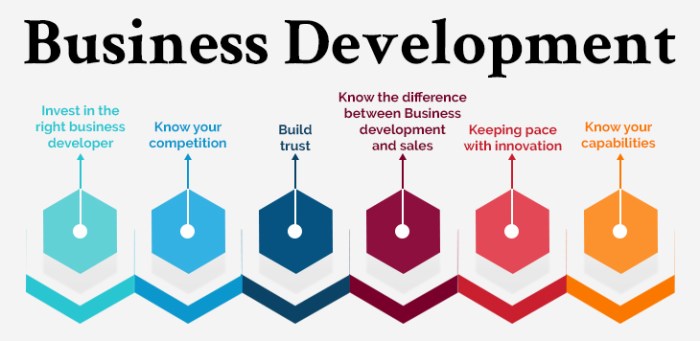
Strategic planning forms the bedrock of successful business development. It provides a roadmap, guiding a company’s efforts towards achieving its objectives and maximizing its potential for growth. Without a well-defined strategy, even the most innovative ideas and talented teams can struggle to achieve lasting success. A robust plan anticipates challenges, allocates resources efficiently, and allows for adaptable responses to market changes.
Strategic Business Development Plan for a Hypothetical Tech Startup
Let’s consider “InnovateTech,” a hypothetical startup developing a novel AI-powered customer service platform. Their strategic business development plan would involve several key phases. Initially, they’d focus on securing seed funding and building a Minimum Viable Product (MVP). This MVP would then be tested with early adopters to gather valuable feedback, informing product iterations. Concurrently, they would develop a go-to-market strategy, identifying their target audience (small to medium-sized businesses) and crafting a compelling value proposition highlighting cost savings and improved customer satisfaction.
Further phases would encompass scaling operations, expanding into new markets, and exploring strategic partnerships to broaden their reach and influence. Their plan would also include contingency plans for handling potential challenges, such as competition from established players or unexpected technological advancements.
The Importance of Market Research in Business Development Strategy
Market research is paramount in shaping a successful business development strategy. It provides crucial insights into customer needs, preferences, and behaviors, allowing businesses to tailor their products and services accordingly. Thorough market research identifies potential market segments, assesses competition, and reveals emerging trends. For InnovateTech, market research would involve analyzing the current landscape of customer service solutions, identifying the unmet needs of businesses, and understanding the pricing dynamics within the sector.
This research would directly inform their product development, marketing efforts, and overall business strategy, ensuring they are addressing a real market need and offering a competitive solution. Without this understanding, their efforts could be misdirected, leading to wasted resources and missed opportunities.
Best Practices for Setting Realistic and Achievable Business Development Goals
Setting SMART goals – Specific, Measurable, Achievable, Relevant, and Time-bound – is crucial for effective business development. For example, instead of a vague goal like “increase market share,” a SMART goal would be “increase market share among small businesses in the North American region by 15% within the next 12 months.” This clarity allows for effective tracking of progress, facilitates accountability, and provides a benchmark for success.
Realistic goals are grounded in market research and an understanding of the company’s capabilities and resources. They avoid overambitious targets that can lead to discouragement and demoralization. Achievable goals are those that are within reach given the available resources and timeframe, encouraging progress and maintaining team morale. Relevant goals directly support the overall business strategy and contribute to the achievement of long-term objectives.
Time-bound goals establish clear deadlines, creating a sense of urgency and promoting focused action.
Step-by-Step Guide to Developing a Comprehensive Business Development Strategy
Developing a comprehensive business development strategy requires a systematic approach. First, conduct thorough market research to understand the landscape and identify opportunities. Second, define your target market and develop a clear value proposition that resonates with your ideal customers. Third, create a detailed marketing plan outlining your strategies for reaching your target audience. Fourth, establish a sales process that is efficient and effective.
Fifth, build strong relationships with key stakeholders, including partners, investors, and customers. Sixth, continuously monitor and analyze your progress, making adjustments as needed. Seventh, establish a system for tracking key performance indicators (KPIs) to measure the success of your strategies. Finally, foster a culture of innovation and continuous improvement within the organization to ensure long-term growth and success.
This iterative process allows for flexibility and adaptation in response to market changes and emerging opportunities.
Sales and Marketing Techniques in Business Development
Effective sales and marketing are the engines driving business development. They bridge the gap between identifying a target market and converting prospects into loyal customers, fostering sustainable growth. A well-integrated approach leverages various techniques to maximize reach and impact, building brand awareness and driving revenue.
The Role of Content Marketing in Customer Acquisition and Retention
Content marketing plays a crucial role in attracting and retaining customers by providing valuable information and building trust. Instead of directly selling products or services, content marketing focuses on creating engaging content – blog posts, videos, infographics, ebooks – that addresses customer needs and pain points. This establishes the business as a thought leader in its industry, drawing in potential customers organically through search engines and social media.
By consistently delivering high-quality content, businesses cultivate a loyal following, converting leads into customers and fostering long-term relationships. For example, a software company might create a series of blog posts explaining complex technical concepts in simple terms, attracting potential clients who are searching for solutions to their technical challenges. This approach builds trust and credibility, making the company more likely to be chosen when the time comes to make a purchase.
A Comparison of Inbound and Outbound Sales Methodologies
Inbound and outbound sales represent distinct approaches to customer acquisition. Inbound sales focuses on attracting customers through valuable content and online channels. This strategy emphasizes organic reach, relying on search engine optimization (), content marketing, and social media to draw potential customers to the business. Outbound sales, conversely, takes a more proactive approach, directly reaching out to potential customers through cold calling, email marketing, and direct mail campaigns.
Each methodology has its strengths and weaknesses. Inbound sales generally fosters higher trust and brand loyalty, but can take longer to yield results. Outbound sales offers faster results but can be more expensive and less effective in building long-term relationships. A successful business development strategy often incorporates elements of both approaches, creating a balanced and effective sales funnel.
Strategies for Building Strong Customer Relationships
Building strong customer relationships is paramount for long-term business success. Effective strategies involve personalized communication, proactive customer service, and loyalty programs. Personalized communication, such as targeted email marketing or customized product recommendations, demonstrates that the business values individual customer needs. Proactive customer service, anticipating and addressing customer issues before they escalate, demonstrates commitment to customer satisfaction. Loyalty programs, rewarding repeat customers with discounts or exclusive offers, incentivize continued engagement and brand loyalty.
For example, a coffee shop might implement a loyalty card system, offering a free coffee after a certain number of purchases. This fosters a sense of community and encourages repeat business.
Leveraging Social Media for Business Development
Social media platforms offer powerful tools for business development. Businesses can utilize social media to build brand awareness, engage with customers, and generate leads. Strategies include creating engaging content tailored to each platform, running targeted advertising campaigns, and actively participating in relevant online conversations. For instance, a clothing retailer might use Instagram to showcase its products through visually appealing photos and videos, while using Twitter to engage in real-time conversations with customers and respond to inquiries promptly.
Consistent engagement and a well-defined social media strategy can significantly improve brand visibility and drive customer acquisition.
Networking and Relationship Building
In today’s competitive business landscape, cultivating strong professional networks is no longer a mere advantage—it’s a necessity for sustained growth and success. Effective networking and relationship building are fundamental pillars of robust business development, unlocking opportunities for collaboration, knowledge sharing, and ultimately, increased revenue streams. This section will explore the importance of networking, provide practical guidance on navigating industry events, and offer strategies for nurturing enduring professional connections.Effective networking significantly enhances business development efforts.
Building a strong network provides access to a wider pool of potential clients, partners, and investors. It also facilitates the sharing of industry insights, best practices, and innovative ideas, leading to a competitive edge. Moreover, strong relationships built through networking often translate into mutually beneficial collaborations and long-term partnerships, fostering sustainable business growth.
Attending and Participating in Industry Events
Successfully navigating industry events requires a strategic approach. Preparation is key; research the event beforehand, identify key individuals or companies you wish to connect with, and formulate concise introductions that highlight your value proposition. During the event, actively engage in conversations, listen attentively, and demonstrate genuine interest in others. Remember to exchange business cards and follow up promptly.
Consider bringing promotional materials that concisely communicate your company’s offerings. Participating in panel discussions or workshops can significantly boost your visibility and credibility within the industry.
Strategies for Building and Maintaining Professional Relationships
Building and maintaining strong professional relationships requires consistent effort and genuine engagement. Regular communication, even beyond immediate business needs, is crucial. This could involve sharing relevant industry articles, offering support or advice, or simply connecting on a personal level (while maintaining professional boundaries). Active listening and demonstrating empathy are vital for building trust and rapport. Remembering details about individuals and their businesses shows genuine interest and strengthens the connection.
Consider offering value to your contacts through mentorship, introductions, or collaborative projects. Regular follow-ups after initial meetings are essential to solidify relationships.
Post-Meeting Actions Checklist
Following up after meeting a potential business partner is critical for solidifying the connection. This checklist ensures you don’t miss crucial steps:
- Send a personalized thank-you email within 24 hours, reiterating key discussion points and expressing your appreciation for their time.
- Connect on LinkedIn and other relevant professional platforms.
- Share relevant articles or resources that might be of interest to them.
- Follow up within a week to schedule a follow-up call or meeting to discuss potential collaborations further.
- Maintain regular contact, even if no immediate business opportunity exists.
Business Development and Financial Management
Effective business development hinges on a strong understanding and proactive management of finances. Ignoring financial realities can lead to even the most innovative ideas failing to reach their full potential. Sound financial planning is not just about tracking expenses; it’s a crucial strategic tool that drives growth and ensures long-term sustainability.
Budgeting and Financial Forecasting
Budgeting and financial forecasting are essential for guiding business development efforts. A well-defined budget allocates resources effectively, tracks spending against projected income, and highlights potential areas of concern. Financial forecasting, on the other hand, projects future financial performance, enabling proactive adjustments to business strategies. For example, a small bakery expanding into wholesale might forecast increased ingredient costs and adjust pricing or explore more efficient sourcing strategies based on these projections.
This proactive approach minimizes risks and maximizes opportunities for success. Accurate forecasting allows for informed decision-making, ensuring resources are allocated effectively to support business development initiatives.
The Role of Business Loans in Supporting Business Growth
Business loans provide crucial capital for expansion, allowing businesses to invest in new equipment, hire personnel, or launch marketing campaigns. Different loan types cater to various needs – from short-term lines of credit for immediate expenses to long-term loans for significant investments like purchasing property or developing new product lines. For instance, a tech startup might secure a venture capital loan to fund research and development, while a retail business might obtain a small business administration (SBA) loan to open a new store location.
Access to appropriate financing can be a game-changer, accelerating growth and enabling businesses to seize market opportunities. Careful consideration of loan terms, interest rates, and repayment schedules is vital to ensure the loan supports, rather than hinders, business development.
Securing Funding for Business Development Initiatives
Securing funding involves a multi-step process. It begins with developing a comprehensive business plan that clearly articulates the business’s goals, strategies, and financial projections. This plan serves as the foundation for attracting investors or securing loans. Next, businesses need to identify appropriate funding sources, which could include bank loans, venture capital, angel investors, crowdfunding platforms, or government grants.
The application process often involves presenting a compelling pitch, demonstrating market viability, and showcasing the management team’s expertise. Successfully securing funding requires a clear understanding of the investor or lender’s expectations and the ability to communicate the business’s value proposition effectively.
Financial Model for a Small Business Seeking Expansion
Consider a small coffee shop aiming to open a second location. A simplified financial model might include:
| Item | Projected Year 1 | Projected Year 2 |
|---|---|---|
| Revenue | $200,000 | $300,000 |
| Cost of Goods Sold | $60,000 | $90,000 |
| Operating Expenses (Rent, Salaries, Utilities) | $80,000 | $100,000 |
| Loan Repayment | $20,000 | $20,000 |
| Net Profit | $40,000 | $90,000 |
This model provides a basic overview of projected income and expenses. A more comprehensive model would include detailed breakdowns of costs, sensitivity analyses, and various scenarios to account for potential uncertainties. This allows for informed decision-making regarding expansion plans and resource allocation. This type of model, while simplified, illustrates the core components needed for assessing the financial viability of expansion.
Ethical Considerations in Business Development
Building a successful business requires more than just shrewd strategies and effective marketing; it demands unwavering ethical conduct. Ethical business development isn’t merely a matter of compliance; it’s a cornerstone of long-term sustainability, fostering trust with clients, partners, and the wider community. A commitment to ethics strengthens brand reputation, attracts and retains talent, and ultimately contributes to greater profitability.Ethical conduct in business development encompasses all aspects of the process, from initial market research to final contract negotiations.
It involves transparency in dealings, fairness in competition, and a commitment to responsible practices that benefit all stakeholders. Ignoring these principles can lead to significant short-term and long-term repercussions.
Consequences of Unethical Business Practices
Unethical business practices can severely damage a company’s reputation, leading to a loss of customer trust and market share. Legal ramifications, including hefty fines and lawsuits, are also a significant risk. Beyond financial penalties, unethical behavior can negatively impact employee morale and recruitment efforts, making it harder to attract and retain top talent. In the long run, a company’s reputation for unethical behavior can make it difficult to secure funding, form partnerships, or even operate effectively.
For example, a company found guilty of bribery or price-fixing could face substantial fines, reputational damage, and difficulty securing future contracts. The erosion of public trust can be particularly damaging, leading to boycotts and a sustained decline in sales.
Examples of Ethical Business Development Strategies
Many companies have successfully integrated ethical considerations into their business development strategies. Patagonia, for instance, is renowned for its commitment to environmental sustainability, using recycled materials and supporting environmental causes. This ethical approach has resonated strongly with consumers, building a loyal customer base and enhancing their brand image. Similarly, Unilever’s Sustainable Living Plan focuses on reducing its environmental impact and improving the lives of people in its supply chain.
This commitment to social responsibility not only enhances their reputation but also strengthens their relationships with suppliers and consumers. These examples demonstrate that ethical practices can be a powerful competitive advantage.
A Code of Conduct for a Business Development Team
A robust code of conduct is essential for ensuring ethical behavior within a business development team. This code should clearly Artikel expectations for all team members, covering areas such as:
Fair competition: We will engage in fair and honest competition, avoiding any practices that could be considered anti-competitive, such as price-fixing or bid-rigging.
Transparency and honesty: We will be transparent and honest in all our dealings with clients, partners, and colleagues. We will avoid misleading or deceptive practices.
Confidentiality: We will maintain the confidentiality of sensitive information obtained during business development activities.
Compliance with laws and regulations: We will comply with all applicable laws and regulations, including those related to anti-bribery and corruption.
Respectful relationships: We will treat all individuals with respect and dignity, regardless of their position or background. We will foster a collaborative and inclusive work environment.
Data Privacy: We will adhere to all relevant data protection regulations and ensure the responsible handling of all client and company data.
This code of conduct should be regularly reviewed and updated to reflect changes in laws, regulations, and best practices. Furthermore, the company should provide training to ensure all team members understand and adhere to the code. Regular audits and reporting mechanisms can help to monitor compliance and identify any areas for improvement.
The Role of Business Coaching in Development
Business coaching offers a powerful mechanism for accelerating business development. By providing external expertise and objective perspective, a skilled coach can help businesses identify blind spots, refine strategies, and unlock their full potential for growth. This support extends beyond simply improving individual performance; it fosters a culture of continuous improvement and empowers teams to achieve ambitious goals.Effective business development hinges on strategic thinking, efficient execution, and adaptability.
A business coach acts as a guide, providing the tools and support necessary to navigate the complexities of the market and achieve sustainable success. This partnership allows business owners and leaders to focus on their core competencies while leveraging the coach’s expertise in areas like strategic planning, team dynamics, and sales optimization.
Benefits of Hiring a Business Coach
Hiring a business coach provides several key advantages. Coaches offer unbiased perspectives, identifying weaknesses and opportunities that internal teams might overlook. They provide structured frameworks and methodologies for improving processes, leading to increased efficiency and productivity. Furthermore, coaches act as accountability partners, ensuring that goals are met and progress is tracked effectively. This external accountability can be particularly beneficial for entrepreneurs or business leaders who may struggle with self-discipline or delegation.
A tangible benefit is often seen in improved profitability and increased market share resulting from the implementation of refined strategies.
Key Skills and Qualities of an Effective Business Coach
An effective business coach possesses a unique blend of skills and qualities. They must be adept listeners, able to understand the nuances of a business’s challenges and aspirations. Strong analytical skills are essential for identifying areas for improvement and developing effective strategies. Furthermore, effective coaches are skilled communicators, able to articulate complex concepts clearly and concisely. Crucially, they must possess a high level of emotional intelligence, understanding the dynamics of team interactions and individual motivations.
Experience in the specific industry or sector is also a significant advantage, allowing the coach to provide context-specific advice and guidance. Finally, a commitment to ongoing professional development ensures that the coach remains current with best practices and emerging trends.
Examples of Business Coaching Enhancing Team Performance and Growth
Consider a small tech startup struggling with inconsistent sales performance. A business coach might implement a sales training program focusing on effective lead generation and closing techniques. This results in a measurable increase in sales conversions and revenue. In another scenario, a large corporation experiencing low employee morale and high turnover could benefit from a coach who facilitates team-building exercises and leadership development workshops.
This could lead to improved employee engagement, reduced turnover, and increased productivity. A third example could be a family-owned business facing succession planning challenges. A business coach could guide the family through a structured process to ensure a smooth transition of ownership and leadership, minimizing potential conflict and preserving the business’s long-term viability.
Comparison of Business Coaching Methodologies
Several coaching methodologies exist, each with its strengths and weaknesses. For example, the GROW model (Goal, Reality, Options, Will) provides a structured framework for goal setting and action planning. Conversely, a more holistic approach might incorporate elements of positive psychology and mindfulness to address emotional well-being and enhance resilience. Some coaches focus on a purely results-oriented approach, while others prioritize personal development and leadership growth.
The choice of methodology will depend on the specific needs and goals of the business and the preferences of the business owner or leadership team. The optimal approach often involves a tailored combination of techniques, drawing on the coach’s experience and the client’s unique circumstances.
Business Models and Strategies
A well-defined business model is the cornerstone of any successful venture. It acts as a roadmap, outlining how a company creates, delivers, and captures value. Without a clear business model, companies risk misallocating resources, failing to attract investors, and ultimately, failing to achieve their objectives. Choosing and implementing the right model is crucial for navigating the competitive landscape and ensuring long-term viability.The selection of a business model directly impacts a company’s revenue streams, cost structure, and overall profitability.
A poorly chosen model can lead to unsustainable growth, while a well-chosen one can facilitate rapid expansion and market dominance. Understanding the nuances of different models and their suitability for a specific product or service is paramount.
Business Model Comparison: Subscription vs. Freemium
Subscription and freemium models represent two distinct approaches to monetization. The subscription model involves recurring payments for access to a product or service, offering predictable revenue streams and fostering customer loyalty. Examples include streaming services like Netflix and Spotify, or software-as-a-service (SaaS) platforms. In contrast, the freemium model offers a basic version of a product or service for free, while charging for premium features or functionalities.
This model attracts a large user base and can lead to significant revenue generation from a smaller percentage of paying users. Examples include popular mobile games and certain software applications. While both models have their merits, the choice depends on factors like the nature of the offering, target market, and overall business strategy. A subscription model works well for products or services with ongoing value, while a freemium model is suitable for products that can be easily segmented into free and paid tiers.
Business Model Canvas for a Personalized Fitness App
Let’s consider a new innovative product: a personalized fitness app that uses AI to tailor workout routines and nutritional plans to individual user needs and goals. The Business Model Canvas for this app would look like this: Customer Segments: Individuals aged 18-55 seeking personalized fitness plans, encompassing various fitness levels and goals. Value Propositions: AI-powered personalized workout and nutrition plans, progress tracking, community features, expert guidance, and convenience.
Channels: App store distribution (iOS and Android), social media marketing, influencer collaborations, and partnerships with fitness centers. Customer Relationships: In-app support, personalized feedback, community forums, and email communication. Revenue Streams: Subscription model with different pricing tiers based on features and access levels (e.g., basic, premium, elite). Key Activities: AI algorithm development and maintenance, content creation (workouts, nutrition plans), community management, customer support. Key Resources: AI technology, fitness and nutrition experts, app developers, and marketing team.
Key Partnerships: Fitness equipment manufacturers, nutrition brands, and health professionals. Cost Structure: Technology infrastructure, personnel costs, content creation, marketing and advertising expenses.This canvas provides a clear and concise overview of the app’s business model, highlighting its key components and relationships.
Developing a Robust Business Strategy
Developing a robust business strategy requires a thorough understanding of the chosen business model, market analysis, competitive landscape, and financial projections. This involves defining clear objectives, identifying key performance indicators (KPIs), and establishing a plan for achieving those objectives. For example, a company adopting a subscription model might focus on strategies to increase customer retention and lifetime value, while a company using a freemium model might prioritize user acquisition and conversion rates.
The strategy should be dynamic, adaptable to changing market conditions, and regularly reviewed and refined based on performance data and market feedback. This iterative process ensures that the business remains aligned with its chosen model and continues to evolve in a competitive market. A well-defined strategy ensures the business model translates into tangible results.
The Impact of Business Travel on Development
Business travel remains a crucial component of successful business development, despite the rise of virtual communication tools. While video conferencing offers convenience, the personal connection forged during in-person meetings often proves invaluable for building trust, solidifying relationships, and ultimately closing deals. The face-to-face interaction allows for a deeper understanding of nuances in communication, fostering stronger rapport and a more collaborative environment.The strategic use of business travel can significantly enhance a company’s development trajectory.
However, maximizing its impact requires careful planning and execution to ensure efficiency and cost-effectiveness. Failing to plan adequately can lead to wasted time, missed opportunities, and unnecessary expenses, undermining the potential benefits of travel.
The Role of Business Travel in Relationship Building and Deal Closing
Effective business travel facilitates the creation and nurturing of crucial relationships. Meeting clients, partners, and potential investors in person allows for a more personal and engaging interaction than virtual meetings can provide. This personal touch can be pivotal in building trust and establishing long-term relationships, which are essential for sustainable business growth. Furthermore, the ability to directly address concerns, negotiate terms, and build consensus in person often proves more effective than relying solely on remote communication when closing deals.
For example, a face-to-face meeting can allow for a better understanding of body language and unspoken cues, leading to more successful negotiations.
Efficient Travel Planning for Business Development
Efficient travel planning is paramount for optimizing the return on investment (ROI) of business trips. A well-structured itinerary ensures that every meeting is productive and that travel time is minimized. This includes researching the best routes and transportation options, scheduling meetings strategically to avoid unnecessary travel time, and securing accommodations that are both comfortable and conveniently located. For instance, choosing a hotel near the conference venue or client’s office can save valuable time and reduce stress.
Furthermore, pre-planning and scheduling all necessary appointments and meetings beforehand is crucial.
Technology’s Role in Enhancing Business Travel Efficiency
Technology plays a significant role in streamlining business travel and maximizing productivity. Tools such as travel booking apps, expense tracking software, and communication platforms can greatly improve efficiency. For example, apps that allow for seamless booking of flights and hotels can save considerable time and effort. Expense tracking software simplifies the process of managing and reporting business travel expenses, reducing administrative burden and improving accuracy.
Real-time communication tools enable quick and easy communication with colleagues, clients, and partners while traveling, maintaining momentum and productivity.
Best Practices for Managing Business Travel Expenses
Managing business travel expenses requires discipline and organization. Developing a clear expense policy and adhering to it rigorously is crucial. This involves setting clear guidelines for allowable expenses, such as per diem rates for meals and accommodation. Using corporate credit cards and expense tracking apps helps maintain accurate records and simplifies the reimbursement process. Regularly reviewing expenses and identifying areas for potential savings can significantly reduce overall travel costs.
For example, opting for economy class flights or utilizing alternative transportation options like trains when feasible can lead to considerable cost savings without compromising productivity.
Mastering effective business development is a continuous journey of learning and adaptation. By embracing a holistic approach that integrates strategic planning, robust marketing, strong networking, ethical practices, and continuous learning, businesses can unlock their full potential. The techniques discussed here provide a solid foundation for building a sustainable and successful enterprise, emphasizing the importance of long-term vision and adaptable strategies in an ever-changing market.
FAQ Section
What is the difference between inbound and outbound sales?
Inbound sales focuses on attracting customers through content marketing and other strategies, while outbound sales actively seeks out potential clients through direct outreach.
How can I measure the effectiveness of my business development efforts?
Key Performance Indicators (KPIs) such as lead generation, conversion rates, customer acquisition cost, and customer lifetime value can provide valuable insights into the effectiveness of your business development strategies.
What is the role of a business coach in business development?
A business coach provides guidance, support, and accountability to help businesses refine their strategies, overcome challenges, and achieve their goals. They offer objective perspectives and expertise to enhance performance.
How important is ethical conduct in business development?
Ethical conduct is paramount. Unethical practices can damage reputation, erode trust, and ultimately hinder long-term success. Maintaining integrity builds strong relationships and fosters sustainable growth.


